Ingrown hairs in the intimate area: why they happen and how to get rid of them
Why hair in the intimate area grows inwards, how to prevent inflammation, what to do with an ingrown hair and why ingrowth disappears completely after laser hair removal.

What is an ingrown hair and how does it happen?
An ingrown hair is a hair that grows into the skin instead of out of it. Under the skin it has nowhere to grow, so it stays markedly short and stunted. Because its behaviour is not physiological, the body perceives it as a foreign object and triggers a defensive inflammatory reaction.
Almost exclusively short hair grows inwards — the scalp is spared this trouble. The most common trigger is depilation or an attempt at partial epilation: a hair stopped in its growth or with a partially damaged root no longer has enough strength to grow correctly and starts to “panic”.
Other factors add to it:
- a blocked channel — dead skin cells and sebum block the hair’s way out
- pressure and friction — overly tight clothing and body folds trap the hair under the skin
- the type of hair — stronger, coarser and less pliable growth grows inwards far more often than fine down
- hormonal balance — increased production of sex hormones leads to more hair growth and raises the risk of ingrowth
Why does hair grow inwards particularly in the intimate area?
Intimate areas are especially prone to ingrowth because of the combination of delicate skin and coarse hair. The skin in the lower bikini area is exceptionally fine and sensitive, yet the hair growing from it is firm, strong, dense and inclined to curl — exactly the type that grows inwards best.
Anatomy and clothing make it worse. There are many folds in these areas and during the day they are usually wrapped in close-fitting underwear. Compare the density and thickness of hair in the underarms or on the legs with the intimate area and the difference is obvious at first glance.
How do I recognise an ingrown hair and when is it already inflammation?
An ingrown hair usually announces itself with pain. A red swelling or lump forms, it itches and is often very painful to the touch. The immune system tries to fight the “foreign body”, releases defensive cells and the reaction may end in the formation of pus.
Inflammation also attracts bacteria, which gather in the affected area and multiply the defensive reaction. Scratching opens the gate for them, so the trouble escalates.
Inflammation of an ingrown hair also has to be distinguished from inflammation of the hair follicle, the structure surrounding the root deep in the skin. That shows as reddish nodules around the hair and often has nothing to do with the direction of growth — it tends to be caused by bacteria, typically with poor hygiene after shaving.
The most common complaints clients report:
| Level of the problem | How it shows |
|---|---|
| Physical discomfort | intense itching, harder to sit and to do sport, tight jeans double the itching |
| Aesthetics | red, tender sores that sometimes suppurate — swimwear is out |
| Health risk | inflammation, in severe cases suppurating fistulas and subsequently an abscess |
Extensive inflammation, a suppurating fistula or an abscess should always be checked by a doctor and treated under strict hygienic conditions. Do not handle such a spot at home — the bacteria could spread.
What to do when a hair does grow inwards
Proceed from the gentlest intervention to the more decisive, and never pull an ingrown hair out — the goal is only to uncover it so it can grow out of the skin normally.
- Hold a warm cloth on the spot for a few minutes so the skin soaks and the pores soften and open.
- Try gently lifting the ingrown hair towards the surface of the skin.
- Use a cream with salicylic acid — it loosens the swollen skin and with it the hair.
- If that does not help, lever the hair out with a sterilised needle or tweezers and disinfect the spot.
- If inflammation has developed, do not handle the spot; more severe cases belong to a doctor.
Prevention is simpler than treatment. Regular exfoliation is key: it removes dead cells and makes the hair’s way up easier. Ideally do it the day before shaving. Retinoids supporting gentle exfoliation also help, as do products with soothing and antiseptic ingredients such as tea tree oil, aloe vera, lavender or chamomile.
Which hair removal method encourages ingrowth the most?
The riskiest is ordinary shaving, that is cutting off the visible part of the hair. Classic epilation is not without risk either: a weakened root seems to lose strength and, as the hair grows back, it curls and loses direction.
| Method | How long the skin stays smooth | Risk of ingrowth |
|---|---|---|
| Shaving with a razor | barely 24 hours | the highest — the hair is only cut off |
| Waxing | usually 2–3 weeks | high if the hair snaps |
| Sugar paste | usually 2–3 weeks | high, the principle is the same as with wax |
| Electric epilator | several weeks | high, the new hair is weaker and thinner |
| IPL | months | the follicle recovers over time and the hair can grow inwards again |
| Laser hair removal | lastingly, after a series of 5–8 sessions | none — the root is destroyed |
The shared disadvantage of the classic methods is simple: they have to be repeated constantly, because the hair keeps growing back. To that add the time and the cost of creams, gels and hygiene products.
How does laser hair removal solve ingrowth?
Laser hair removal is the only method that can make it impossible for hair to regrow. The laser beam travels from the tip of the hair through its body down to the root, and the delivered energy destroys the root without damaging the surrounding tissue. Where there is no follicle there is no hair — and nothing to grow inwards.
Hair whose root has been destroyed keeps growing for a few more days. After about two weeks you can pull it out easily, or it falls out by itself. During the whole series of treatments not a single hair grows inwards, and after it ends no new one grows at all.
By the way, in online discussions you may come across the phrase “laser depilation”. That is a confusion of terms: a laser always destroys the hair follicles, so it is epilation.
How does laser hair removal of the intimate area work?
The treatment takes only a few minutes and is done lying on a treatment bed. The procedure has three steps:
- Examining the zone — we inspect the area thoroughly and cover any moles or tattoos so the laser does not hit them.
- Applying gel — ultrasound gel cools the skin and helps the handpiece glide, so it adheres better and works more effectively.
- The treatment itself — we go over the bikini area with the laser and, on request, other intimate areas as well.
Because not all hair grows at the same time and there are several growth phases, the treatment has to be repeated several times — usually 5 to 8 sessions. Thanks to the output of a modern device we treat as much hair as possible in one session, so you will notice a difference after the first one, and the interval between treatments is 4 to 8 weeks.
Discretion goes without saying. For epilation of the groin (the bikini zone) the procedure commonly takes place in underwear. We treat neighbouring zones just as gently — if the growth on the rear bothers you, read how hair removal on the buttocks works.
How much does intimate hair removal cost?
The prices are per session. We confirm the exact extent and price at the free consultation.
| Zone | Price per session |
|---|---|
| Deep bikini | 2 500 CZK |
| Classic bikini | 1 500 CZK |
| Buttocks | 1 500 CZK |
| Intergluteal cleft | 1 000 CZK |
The higher price compared with shaving is balanced by the durability of the procedure, its gentleness to the skin and the comfort — which is, after all, the most common conclusion people reach in online forums too. They highlight the long-term results, less skin irritation, a low chance of ingrowth, and the fact that only a few sessions are needed for a lasting effect.
What else you need to know before the first treatment
A laser is safe, but it should be certified and in the hands of professionals: with the wrong settings the treatment may not be as effective, or a light burn of the skin may occur. It therefore pays to choose a clinic by its equipment and the experience of its staff.
Do not expect miracles after the first session — the result depends on the effectiveness of the device and the density of the hair, and the series of sessions has its reason. Pain is minimal according to most experiences: the laser targets the follicles precisely and the devices have built-in cooling that numbs the skin, so clients describe a light sting at most.
The treatment is not suitable during pregnancy and breastfeeding, nor for people with epilepsy, thrombotic conditions, diabetes or those taking photosensitising medication. Always discuss your health with the specialist.
At Laser Clinic we work with two types of laser — the diode LightSheer DUET and the alexandrite Deka Motus AX Moveo — and choose the right device according to the type of skin and hair at the free consultation. If you still shave yourself for now, at least go through the correct shaving procedure so you do not cause ingrowth unnecessarily.
Nabídka měsíce
−50 %na klasické bikiny i bérce
Ke 3 zónám přidáme podpaží zdarma.
Sleva platí tento měsíc na klasické bikiny a bérce s koleny. Při výběru 3 placených zón přidáme podpaží zdarma navíc. Zvýhodnění uvidíte i v kalkulačce níže; podmínky potvrdíme telefonicky, žádné skryté příplatky.
Frequently asked questions
The most common cause is shaving and depilation: a weakened or shortened hair loses direction and grows under the skin. Add a channel blocked by dead cells and sebum, pressure and friction from tight underwear, and the very type of pubic hair, which is strong, dense and curly.
First try softening the skin with a warm cloth held on for a few minutes and gently lifting the hair towards the surface, or use a cream with salicylic acid. If that does not help, release the hair with a sterilised needle or tweezers and disinfect the spot — do not pull the hair out, only uncover it.
Yes. The laser destroys the root of the hair, so no new hair grows from it and there is nothing to grow inwards. Over a series of sessions all the hair in the given area is treated this way.
Usually 5 to 8 sessions, because the hair does not all grow at the same time and the laser has to catch each one in its growth phase. The interval between treatments is 4 to 8 weeks and you will notice a difference after the very first session.
Avoid the treatment during pregnancy and breastfeeding. It is also unsuitable for people with epilepsy, thrombotic conditions, diabetes or those taking photosensitising medication. Always discuss your health with the specialist at the free consultation.
Related articles

How to shave intimate areas step by step
How to shave intimate areas without irritation? A six-step procedure, the tools, aftercare and the mistakes that cause spots and ingrown hairs.

How to shave your buttocks: step by step and without irritation
How to shave your buttocks safely: preparation, trimming, shaving technique and aftercare. The most common mistakes that lead to spots, and when a laser is the better choice.
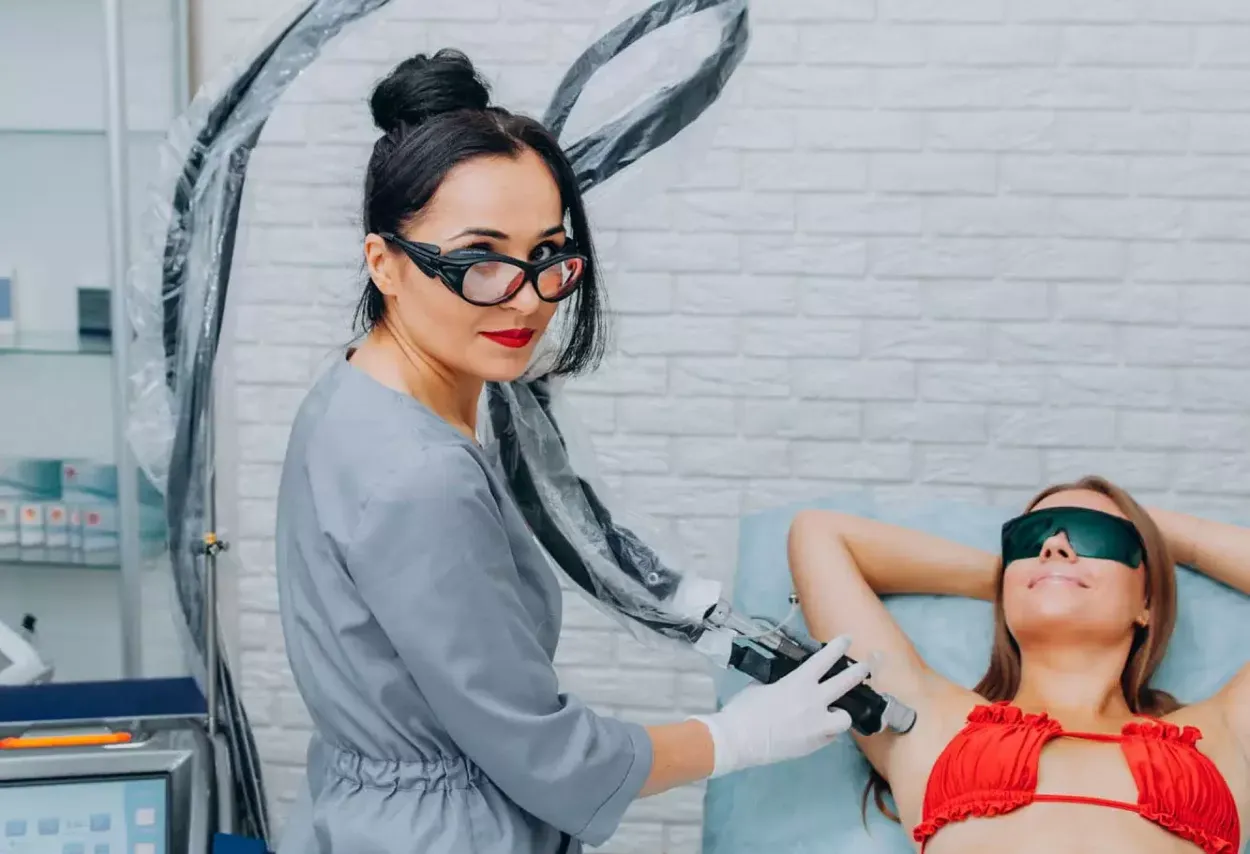
Ingrown hairs in the underarms: causes, prevention and solutions
Why underarm hair grows inwards, how to recognise inflammation and what to do about it. A comparison of hair removal methods, prevention, and how laser hair removal of the underarms solves ingrowth.