Laser hair removal and risks: contraindications and side effects
What risks laser hair removal carries, who it is not recommended for and which side effects are normal. An overview of contraindications and the rules that minimise them.
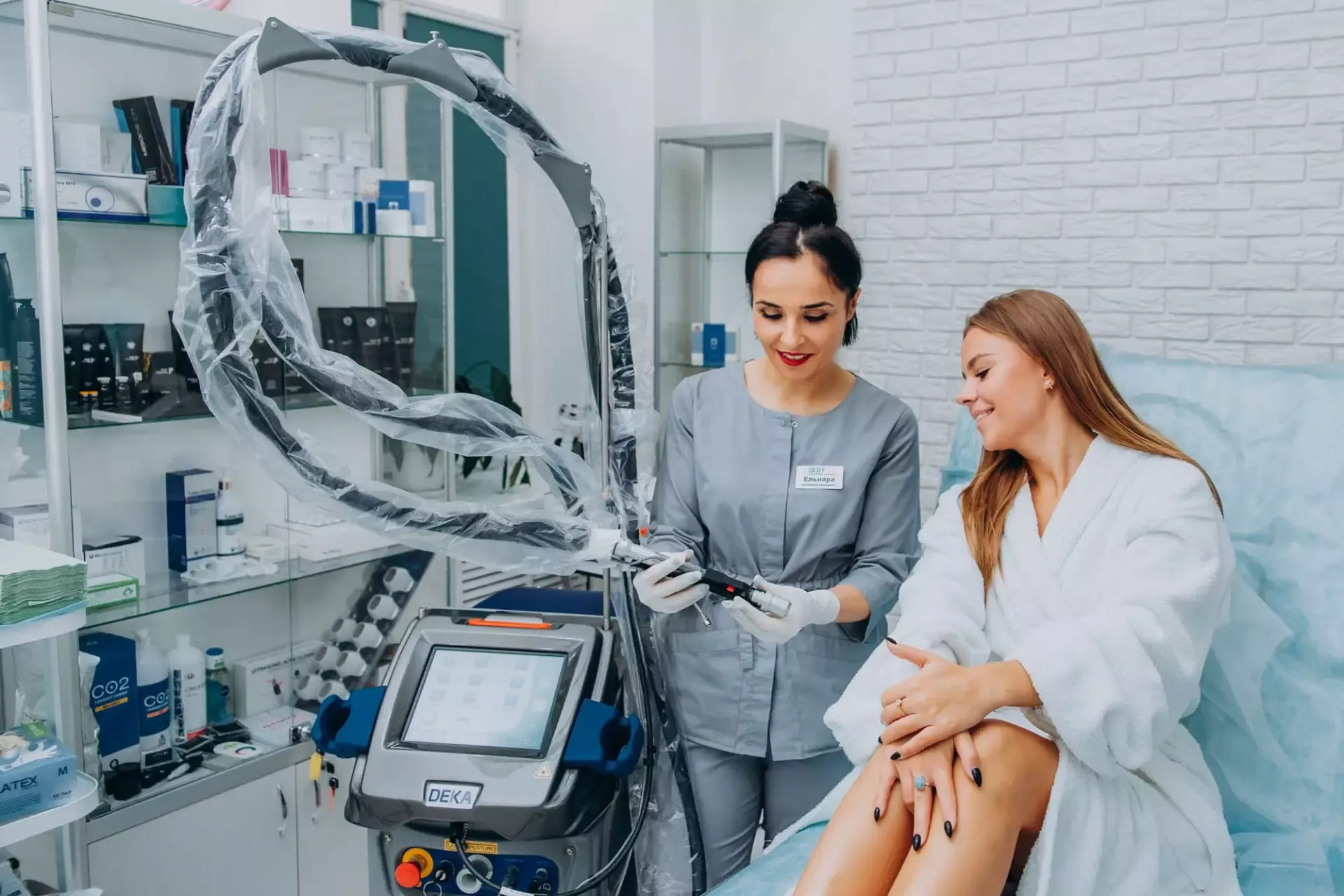
What risks does laser hair removal carry?
Laser hair removal is safe and most clients tolerate it very well, but it is not without risks. The common reaction is mild redness and itching of the treated spot, which usually subsides on its own within a few hours. The serious risk — a skin burn or eye injury — practically always arises from two causes: an outdated or lower-quality device and insufficiently trained staff.
Which side effects are normal after laser hair removal?
The expected reactions are mild and usually subside within a few hours to two days: redness, mild swelling around the follicles and a feeling of warmth in the treated spot. This is not a complication but a normal reaction of the skin to the delivered energy. They include:
- Mild redness or swelling of the treated spot — shows mainly in very sensitive people and usually subsides soon.
- Itching of the skin — a common phenomenon that usually recedes on its own within a few hours after the procedure. If the trouble persists, we will recommend a soothing ointment.
- Gradual shedding of the hair roughly a week to 30 days after the application. That is not a complication but the desired effect — this is what a destroyed follicle looks like.
- A feeling of burning or stinging during the application itself in more sensitive people. Pain is highly individual; most clients tolerate the individual applications very well.
Two side effects deserve extra explanation:
Hyperpigmentation. Dark spots may form on the skin — this is a reaction to sunlight, not to the laser itself. You prevent it with gentle sunscreens with a high SPF and by not sunbathing deliberately for at least a month after the procedure. Planning a summer holiday? Then it is ideal to start the series in autumn.
Burns and scars. These serious complications are exceptional at qualified providers and are almost always the result of human failure — an operator without professional training, or outdated and poor-quality equipment. So do not be tempted by a suspiciously advantageous price offer.
During healing you must not scratch and you need to protect the skin from mechanical damage. Conscientiously following the instructions before and after the procedure markedly lowers the risk of unpleasant side effects.
Can laser hair removal cause cancer?
No. The laser beam penetrates only a few millimetres into the skin and its radiation is not ionising — unlike an X-ray, for example, it does not damage cell DNA. For the same reason the laser does not act on the thyroid gland either, which is another worry that often comes up around epilation.
At the same time, no procedure is entirely without risk and everyone reacts differently. That is exactly why health is assessed individually and why it is important to speak openly about your diagnoses.
Who is laser hair removal not recommended for?
Laser hair removal is not suitable for everyone without exception. The following conditions are contraindications that must be reported before the first application:
| Group | Specific contraindication |
|---|---|
| Physiological states | Pregnancy and breastfeeding |
| Neurological conditions | Epilepsy |
| Acute infections | Any ongoing acute infection in the body |
| State of the skin | Acute skin inflammation, rashes, acne, open wounds, skin infections, mechanical damage to the skin, keloid scars |
| Pigment in the skin | Tattoos, permanent make-up, hyperpigmentation |
| Serious illness | Cancer, a history of skin cancer, blood clotting disorders |
| Reaction to light | A sensitive reaction to sunlight |
| Chronic conditions | Always inform the treating practitioner about your diagnosis and the medication you take |
Three situations deserve emphasis in particular. Pregnant and breastfeeding women cannot undergo laser hair removal — plan the sessions after breastfeeding ends. If you have just finished a course of antibiotics, the treatment has to be postponed by 4 to 6 weeks after stopping them. And if a hormonal cause lies behind the excessive hair growth — hirsutism, polycystic ovary syndrome or a thyroid condition — the laser deals with the visible symptom, not the cause. That has to be discussed with a doctor first, who can start the appropriate treatment.
The final assessment always belongs to the specialist at the initial consultation. With us it is free precisely so the state of the skin and any contraindications are evaluated before the first pulse. If you suffer from a specific chronic condition, inform your treating doctor about your plans as well.
The two most common myths about the risks
Myth 1: Laser hair removal hurts as much as wax. Pulling hair out with a common epilation method hurts, the skin is irritated afterwards and may even bleed — and many people judge the laser by that. But with laser hair removal the hair is not pulled: light energy eliminates it together with the follicle. Most clients describe the laser as a light sting. The cooling integrated in the device also chills the treated area down to −4 °C, which numbs it temporarily, and a local anaesthetic can be applied before the treatment on request. For most clients, though, the cooling alone is more than enough.
Myth 2: A laser is not suitable for darker skin. Darker or tanned skin and lighter hair can be a contraindication, but practically only with a diode device — that handles dark hair on a light phototype best, which is why applications with it tend to be planned for the autumn and winter months. The alexandrite Deka Motus AX Moveo works on darker skin too and manages lighter hair, so with it epilation can be spread across the whole year — the tan just must not be completely fresh.
Why does the risk of burns arise and how do you avoid it?
The risk of burns has three main sources: an unsuitable type of device for the given phototype, badly chosen settings and untrained staff. The laser works with pigment — light energy turns into heat in melanin. If there is too much pigment in the skin (a darker phototype, a fresh tan, tattoos, pigment spots), the energy is absorbed not only by the hair but by the skin as well.
Four things that keep the risk to a minimum:
- The right type of laser. Common diode devices work best on dark hair on light skin. Alexandrite lasers manage even where the contrast between hair and skin colour is smaller. At Laser Clinic we work with two devices — the diode LightSheer DUET and the alexandrite Deka Motus AX Moveo — and choose the right one according to your skin and hair type at the free consultation.
- A qualified operator. An experienced professional can aim a powerful device precisely and thereby achieve the result with minimal risk of burns or injury to the skin and eyes.
- Cooling. The cooling system integrated in the device chills the skin at that point and increases both the safety and the comfort of the procedure. Thanks to it most clients do not need a local anaesthetic, even though it is available on request.
- Protective goggles. You wear them throughout the treatment, whether it is the face or another part of the body — they protect the eyes from the direct and the reflected laser beam.
How do you prepare for the procedure to keep the risk as low as possible?
The preparation is not a formality — most complications arise from breaking it. The rules are simple and apply to all zones.
| When | What to do |
|---|---|
| 4 weeks before | Do not use any other epilation method (wax, sugar paste, epilator). Only shave the hair with a razor or trimmer |
| 4–6 weeks after antibiotics | Postpone the treatment |
| 7 days before | Do not expose the skin to direct sun, do not sunbathe actively |
| The day before | Shave the area smooth and do not drink alcohol |
| On the day of the visit | Do not apply any cosmetic creams or make-up, the skin must be clean |
Why the ban on wax and epilators? The laser needs a hair with its root, which carries the heat to the follicle. If you pull it out beforehand, there is nothing to act on and the whole session goes to waste.
How do you care for the skin after laser hair removal?
The aftercare is simple: skip cosmetics and make-up on the first day, the sauna, the pool and intense sport for 24 to 48 hours, and protect the treated spot from the sun and solariums for the whole first month. It is precisely the failure to protect from the sun that lies behind most pigment spots after treatment. In detail:
- Immediately after the application do not put any aggressive cosmetics or make-up on the treated spots. On the first day go without cosmetic products entirely.
- Afterwards choose ideally natural cosmetics with moisturising effects.
- For a month protect the skin from direct sunlight, do not sunbathe deliberately and use a cream with a high SPF.
- Do not scratch and protect the skin from mechanical damage.
- If it itches, get in touch — a trained specialist will recommend a suitable soothing ointment; cooling the treated spot helps too.
For sensitive areas add a practical detail: wear loose clothing and comfortable underwear to the session, ideally from natural materials. Friction from tight clothes irritates freshly treated skin unnecessarily — just as after shaving, which we cover in the guide on how to shave intimate areas.
What about sunbathing and the season?
A fresh tan is a contraindication, an older tan usually is not. After sun exposure you should wait at least one week. During the summer months the treated skin then has to be protected from direct sun for at least a month.
If you want to enjoy summer without restrictions, there is a simple plan: start in autumn or winter. That way you get a substantial part of the series done before the season and will not be wondering in July whether you are allowed on the beach.
How many treatments are needed and what is the realistic result?
The honest answer is: it does not end with one session and nobody gives a hundred-percent guarantee. The laser acts optimally only on hair in a certain growth phase, and never is all of it in that phase at once — which is why the application has to be repeated.
- Number of sessions: a complete course usually means 5 to 8 sessions spaced four to eight weeks apart, depending on the zone, hair density and hair type. A shorter interval than four weeks makes no sense and the exact plan is set by a trained specialist individually.
- First result: you will notice a reduction of up to 20 % of the hair after the very first application.
- Success rate: in up to 80 % of people who completed the recommended number of treatments, hair does not grow back in the treated spot.
- If the follicle recovers: the hair may start growing again, but there is substantially less of it and it is lighter and generally weaker.
- Maintenance: to keep the skin smooth, one maintenance treatment a year is usually enough.
- Session length: small areas 5 to 20 minutes, large areas 30 to 90 minutes on average.
Laser hair removal is also the only method that solves ingrown hairs in the groin at the root of the problem — without a follicle there is nothing to grow inwards. Compared with the home approaches covered in our article about home remedies for hair removal, that is a fundamental difference.
Not sure whether a laser is right for you? Come and ask at a free consultation — Vinohrady, Karlovo náměstí or Vysočany, every day from 9:00 to 21:00. An open “in your case we do not recommend it” is a better outcome for us than a procedure that would harm your skin.
Nabídka měsíce
−50 %na klasické bikiny i bérce
Ke 3 zónám přidáme podpaží zdarma.
Sleva platí tento měsíc na klasické bikiny a bérce s koleny. Při výběru 3 placených zón přidáme podpaží zdarma navíc. Zvýhodnění uvidíte i v kalkulačce níže; podmínky potvrdíme telefonicky, žádné skryté příplatky.
Frequently asked questions
The common reaction is mild redness and itching, which usually subsides on its own within a few hours. The more serious risk, a skin burn, arises above all at providers with an outdated device or insufficiently trained staff.
Pregnant and breastfeeding women, people with epilepsy, people with cancer, and those with an acute infection, skin inflammation, a rash, open wounds, keloid scars, a tattoo in the treated area or a blood clotting disorder. The chronically ill must always inform the treating practitioner about their diagnosis.
No. The laser penetrates only a few millimetres into the skin and its radiation is not ionising, so it does not damage cell DNA. For the same reason it does not act on the thyroid gland either.
No. Tattoos and permanent make-up are among the contraindications — pigment in the skin absorbs light energy, which raises the risk of damaging the skin.
After sun exposure you should wait at least one week; the tan must not be fresh. After the treatment protect the skin from direct sun for a month and use a cream with a high SPF.
Yes, mild redness, swelling and itching are common and usually subside within a few hours. You must not scratch, though; if the trouble persists, we will recommend a suitable soothing ointment.
Related articles

Epilation vs depilation: the difference and which method to choose
Epilation vs depilation explained: how they differ, how long shaving, wax, an epilator, IPL and a laser last, and which method pays off for which body zone.

Home remedies for hair removal: what works and what is a myth
Turmeric, baking soda, sugar paste and egg white with sugar. What really works among home remedies for hair removal, what only irritates the skin and when only a laser helps.
Ingrown hairs in the underarms: causes, prevention and solutions
Why underarm hair grows inwards, how to recognise inflammation and what to do about it. A comparison of hair removal methods, prevention, and how laser hair removal of the underarms solves ingrowth.